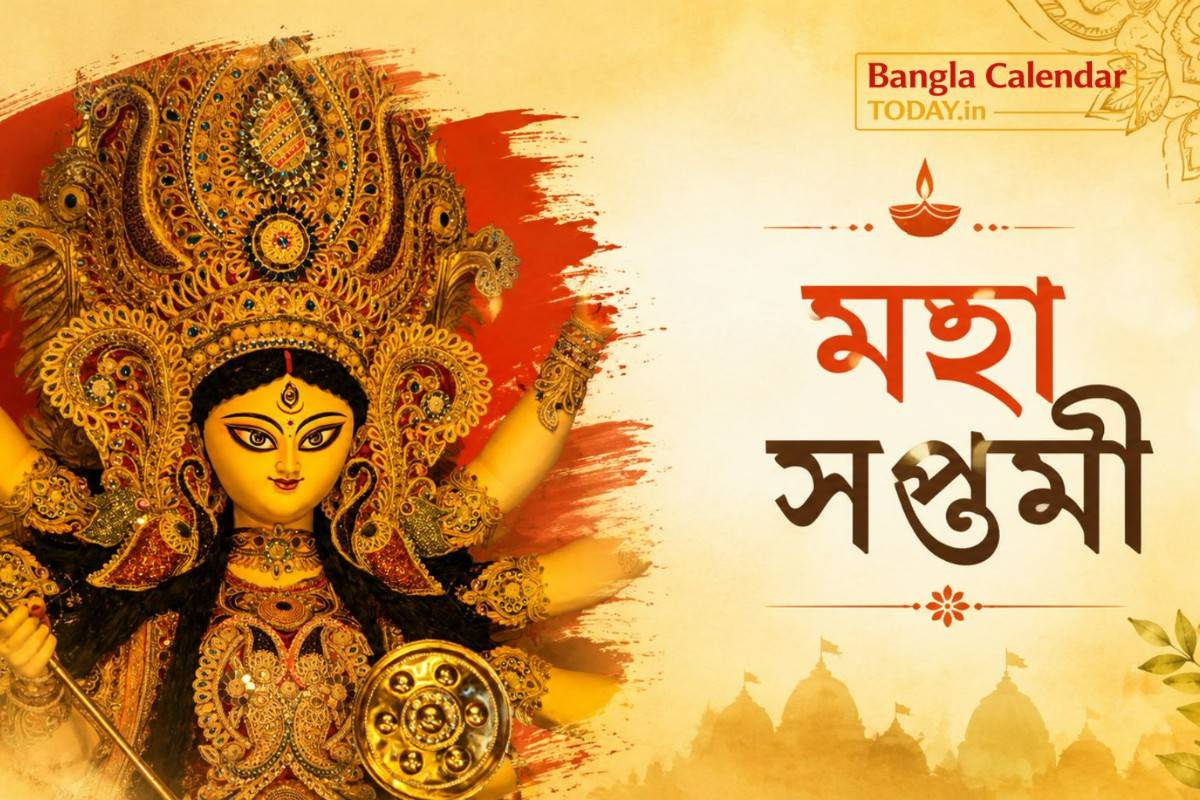
Maha Saptami 2026(মহা সপ্তমী ২০২৬)
Durga Saptami1433 Bengali Panjika • Verified Dates & Timings
Looking for calendar views and tithis?
Read more about the exact tithi timings and planetary alignments in our comprehensive October 2026 Calendar.
About Maha Saptami (Durga Saptami)
উৎসব পরিচিতি
Maha Saptami 2026 (মহা সপ্তমী ২০২৬) is celebrated across two days—Saturday, October 17 and Sunday, October 18, 2026 (corresponding to 1 and 2 Kartik 1433 Bangabda in the Bengali Panjika). Because Saptami Tithi extends over two consecutive sunrises according to the Surya Siddhanta and Gupta Press calculations, the sacred rites are observed with double the devotion.
Maha Saptami marks the official commencement of full-scale ritualistic worship in Durga Puja. The day begins at dawn with the world-famous Nabapatrika Snan (popularly known as Kola Bou Snan). A bundle of nine sacred agricultural plants—symbolizing the nine divine manifestations of Mother Nature and Goddess Durga as Shakambhari—is bathed in the sacred waters of the River Hooghly (Ganga) or local water bodies at sunrise. Draped in an auspicious yellow cotton saree with a red border, the Nabapatrika is brought back and placed to the right of Lord Ganesha on the puja dais.
Following the sacred bath, the priests perform the intricate Pran Pratishtha (the infusing of cosmic breath and consciousness into the clay idol of Maa Durga through sacred Vedic and Tantric mantras). Maha Saptami transforms the clay vigraha into the living, omnipotent Goddess. Massive crowds pour into pandals across Kolkata, Howrah, and Bengal from the morning hours to witness the majestic Shodashopachara Puja (16-step offering), hear the resonant chants of the Chandi Path, and offer early morning Pushpanjali.
History:
The theology of Maha Saptami is deeply anchored in Bengal's agrarian roots and the ancient Shaktism documented in the Markandeya Purana and Kalika Purana. Long before massive decorative community pandals existed, Bengal was an agricultural civilization that worshipped Mother Earth as Shakambhari (the nourisher of vegetation with life-sustaining plants).
The Nabapatrika represents nine forms of Devi embodied in nine natural plants:
- Rambha (Banana plant) representing Goddess Brahmani (cosmic creation)
- Kachvi (Colocasia plant) representing Goddess Kalika (destruction of evil)
- Haridra (Turmeric plant) representing Goddess Durga (protection and health)
- Jayanti (Barley plant) representing Goddess Kartiki (courage and victory)
- Bilva (Wood-apple branch) representing Goddess Shiva (auspiciousness)
- Dalima (Pomegranate twig) representing Goddess Raktadantika (nourishment)
- Asoka (Ashoka branch) representing Goddess Sokarahita (dispeller of sorrows)
- Manaka (Arum plant) representing Goddess Chamunda (spiritual awakening)
- Dhanya (Paddy sheaf) representing Goddess Lakshmi (agricultural wealth)
Historically, during the zamindari era in Nadia, Dinajpur, and Murshidabad during the 17th and 18th centuries, the Nabapatrika was carried in royal palanquins with royal guards, shehnai players, and torchbearers to the riverbank for its dawn bath. Today, this tradition lives on at Kolkata's Bagbazar, Babughat, and Princep Ghat, drawing thousands of spectators, historians, and photographers at sunrise.
Auspicious 2026 Timings & Tithi Nirghanta (সূর্যসিদ্ধান্ত ও বিশুদ্ধ পঞ্জিকা):
- Dates: Saturday, October 17 & Sunday, October 18, 2026 (বাংলা ১ ও ২ কার্তিক ১৪৩৩ বঙ্গাব্দ)
- Kola Bou Snan (Nabapatrika Bath): Dawn sunrise window between 05:36 AM and 06:45 AM IST
- Pran Pratishtha Muhurat: 07:15 AM to 09:30 AM IST
- Saptami Pushpanjali Timings: 09:45 AM to 11:30 AM IST
- Saptami Bhog Arati: 12:30 PM to 01:45 PM IST
- Public Holiday Status: Official Gazetted Public Holiday across West Bengal.
Core Theological & Spiritual Significance:
Maha Saptami establishes the living presence of the Goddess in our midst. While Sasthi is the greeting and awakening, Saptami is the day Devi truly takes residence in the temple through the esoteric Pran Pratishtha ritual. It signifies that nature, food crops, cosmic energy, and human devotion are inseparable.
Community Spirit & Pushpanjali:
For devotees, Saptami is the first day of major community Pushpanjali. Fasting worshippers gather shoulder-to-shoulder with fresh lotus buds, reciting sacred hymns before relishing the famous midday Bhog of Khichuri and Labra.
Rituals & How to Celebrate
Kola Bou Snan (Nabapatrika Bathing at Sunrise) — The priest carries the Nabapatrika bundle to the Hooghly river at dawn, bathing it with sacred water from 8 holy urns (Ashtakumbha), fragrant oils, and river silt.
Nabapatrika Pravesh & Installation — Draped in an auspicious bridal yellow saree with red borders, the Nabapatrika is welcomed back into the pandal and seated to the right of Lord Ganesha.
Pran Pratishtha (Infusing Divine Life) — Using a kusha grass stalk and sacred Vedic mantras, the priest touches the eyes, heart, and limbs of the idols, infusing living divine consciousness into the clay forms.
Chakshu Daan Pratishta & Shodashopachara Puja — The final consecration of the deity's gaze followed by the elaborate 16-fold royal offering of silks, jewels, garlands, lamps, and pure naivedya.
Saptami Pushpanjali — Devotees observe strict morning fasting, offering fresh lotus blossoms and sandalwood-smeared bel leaves while reciting the reverent Saptami Pushpanjali hymn in unison.
Saptami Sandhya Arati & Dhunuchi Naach — Grand twilight arati illuminated by multi-tiered brass lamps, accompanied by fiery Dhunuchi Naach performances to thunderous dhak rhythms.
Traditional Foods & Bhog
Gobindobhog Khichuri Bhog — Aromatic short-grain Gobindobhog rice cooked with roasted golden moong dal, ginger juliennes, green chillies, and homemade desi ghee.
Labra Tarkari — Traditional rich mixed vegetable curry containing seven to nine vegetables like sweet pumpkin, sweet potato, green banana, ridge gourd, and beans, cooked without garlic or onions.
Beguni & Alur Chop — Crisp, golden gram-flour battered fried eggplant slices and spiced potato fritters served piping hot alongside the sacred Khichuri.
Tomato-Khejur Chutney — Sweet and tangy crimson relish prepared with ripe farm tomatoes, soft dates (khejur), sweet dried aamsotto (mango pulp bar), and crunchy roasted panch phoron spices.
Papad & Ghee — Crisp roasted poppadums drizzled with fragrant Jharna or homemade ghee, accompanying the festive prasad plate.
Chanar Payesh & Dorbesh — Rich dessert made of fresh cottage cheese globules slow-cooked in sweetened condensed milk, paired with traditional golden Dorbesh laddu.
Festival Calendar
Oct16
Maha Sasthi 2026 (Durga Sasthi)
৩১ আশ্বিন • মহা ষষ্ঠী (বোধন ও অধিবাস)
Fri
Oct17
Maha Saptami 2026 (Day 1)
১ কার্তিক • মহা সপ্তমী (১ম দিন - নবপত্রিকা স্নান)
Sat
Oct18
Maha Saptami 2026 (Day 2)
২ কার্তিক • মহা সপ্তমী (২য় দিন - সপ্তমী পূজা)
Sun
Oct19
Maha Ashtami 2026 (Durga Ashtami)
৩ কার্তিক • মহা অষ্টমী (কুমারী পূজা ও সন্ধিপূজা)
Mon
Oct20
Maha Navami 2026 (Durga Navami)
৪ কার্তিক • মহা নবমী (নবমী হোম ও বলিদান)
Tue
Oct21
Vijaya Dashami 2026 (Dussehra)
৫ কার্তিক • বিজয়া দশমী (সিঁদুর খেলা ও বিসর্জন)
Wed
Related Festivals
Explore more key pujas & festive dates
Frequently Asked Questions
Quick Info
FestivalMaha Saptami (Durga Saptami)
Date17 October 2026
DaySaturday
Tithiদ্বিতীয়া
Bangla Date১ কার্তিক ১৪৩৩
Pakshaশুক্লপক্ষ
Panjika Details
Sunrise5:50 AM
Sunset5:15 PM
Nakshatraপুষ্যা
Yogaসিদ্ধ
Karanaগর